

Tired of tripping over your kid’s stuff? Get organized and get your kids involved!
We live in a pretty small house compared to the average American home, which has a square footage of 2,600 sq ft. We like it that way, it means a lot smaller mortgage and a lot less spent on upkeep, giving us more time to do other things. However, it also means being very creative with storage solutions, and it makes us very aware of keeping the clutter pared down on a regular basis.
When it comes to kid stuff, it definitely can accumulate quickly. I started working with my son pretty early on letting go of things that he no longer played with or that he had outgrown. I didn’t want to just take stuff and sneak it out of the house; I figured that would lead to a meltdown later on when my son inevitably went looking for it and it was gone.
When he was part of the process, I only had to remind him that he had given it to the babies, and he would just nod and say, “Oh, yeah!” We would usually tell him we could give things to the babies since it was things he no longer played with; which worked pretty well. Of course, when my hubby and I decided to get rid of the doors between our dining room and kitchen, my son immediately exclaimed, “The doors are gone! They went to the babies!” 😂
The ironic thing about living in a small space is I feel as if sometimes we have less clutter than we would if we were in a big house. Big homes often mean you can fit more stuff, but then you acquire more stuff; meaning more stuff strewn everywhere once your toddler-through-teen tornado moves through the room. Since we’re three people in roughly 1330 sq ft., we have regular major purges at least twice a year, and we’re big fans of a ten-minute tidy.
We don’t have a spare playroom, but I didn’t want our den to look like a toy zone, so we got double-duty furniture that could hide toys with a grown-up look. We have a storage ottoman with a tray on top that serves as our coffee table but hides an assortment of trucks. A storage unit with pull-out bins hides Paw Patrol and PJ Masks toys, musical instruments, cars, a farm, costumes, and showcases my son’s books for easy grab-and-go.

Our den closet had become a “cloffice” a long-time ago, so we had taken down the door and replaced it with a curtain. Inside, we installed shelves and my son’s bins of blocks and whatnots live there so he can easily reach them.


In another skinny hall closet, we assembled some activity boxes that we rotate through, instead of having everything out at the same time.


Rotation is awesome! We have several other items that we keep tucked away on upper closet shelves and only bring out now and then, or switch out with other activities; this serves a dual-purpose — it keeps things from getting everywhere, but it also keeps things “new” and interesting for my son because he doesn’t have 24/7 access to everything.
For the items that you keep within your child’s reach, go for multi-bin storage, like this awesome piece from Tot Tutors, which makes it easy for your child to see everything at a glance and easily remove and replace bins. For stuffed animals and similar items, you can opt for a toy hammock to keep things off of the floor.
We also love spending time outside, so there are a few items that live in the backyard, including an art easel and my son’s food truck, which he loves to serve “ice cream” from under the patio. We have created quite a few tents and escapes to bring a little sense of adventure into my son’s backyard play space; hey, it keeps the stuff out of the house!


Here are 15 Ways To Get Kids Involved in Conquering the Clutter (based on age):
TODDLERS
- Use pictures to label your child’s bins so she knows what is inside of them. To get her involved, print out pictures that she can help color.
- Let your child be a part of the sorting and tossing process so she has a sense of control over what stays and goes. Your child will learn that she doesn’t have to keep everything while she builds valuable decision-making skills.
- Each evening, incorporate putting away toys as part of your child’s bedtime routine. Have your child use the picture labels to match items to the appropriate bin; turn it into a fun sorting game.
- If you expect your child to help put things away, make sure she can reach. Place regularly-used toy bins at a height that is easy for your child to access.
- Start working with your child on picking up one thing before moving on to another activity. Make picking up a fun experience by singing or setting a timer and having a “pick-up race.”
YOUNG CHILDREN
- Don’t expect perfection when it comes to chores, but start setting expectations. For example, your child can make her own bed, just don’t stress out if the sheets aren’t perfectly straight.
- Let your child decide what kind of labels she would like for her bins, and then let her help create them.
- Children in this age group can play an even larger role in deciding what to toss. Encourage your child to regularly take stock of what it is she plays with and what she hasn’t touched in a while.
- Have your child help you remove everything from the area being organized and sort like items together.
- Let your child choose the storage items she wants to use, but discuss a budget first, or provide her with some limited options so you will be on board with whichever items she picks.
TEENS
- Your teenager should get most of the control when it comes to getting rid of her unused items. Ask your teen if there is a special charity that she would like to donate some of her things to.
- As a teen, your child can choose what areas of her space she would like to do first and set a timeline for getting it done. Only step in and offer support if she gets stuck, or if she needs a little extra motivation.
- Help your teenager develop a sense of pride in her personal space and for her belongings; this will help her truly want to keep things in place. Express your appreciation and admiration for the job that she is doing. She should be making her own bed, putting her things away regularly, and handling her own laundry.
- Your teen’s room should be her domain; let her have the final say on how to arrange her furniture and set up her space. Let her choose what color she wants to paint her walls. If her room is set up how she wants it, then she’ll be more likely to keep it neat; a space is only truly organized if it works well for the person who lives in it.
- Remind your teen to live with her space for a while and see what works and what doesn’t. If she’s having trouble keeping things a certain way, encourage her to tweak and adapt to better fit her lifestyle. For example, some people do great with hidden storage, while others need to see their stuff (think clear bins, bookshelves, magazine racks).
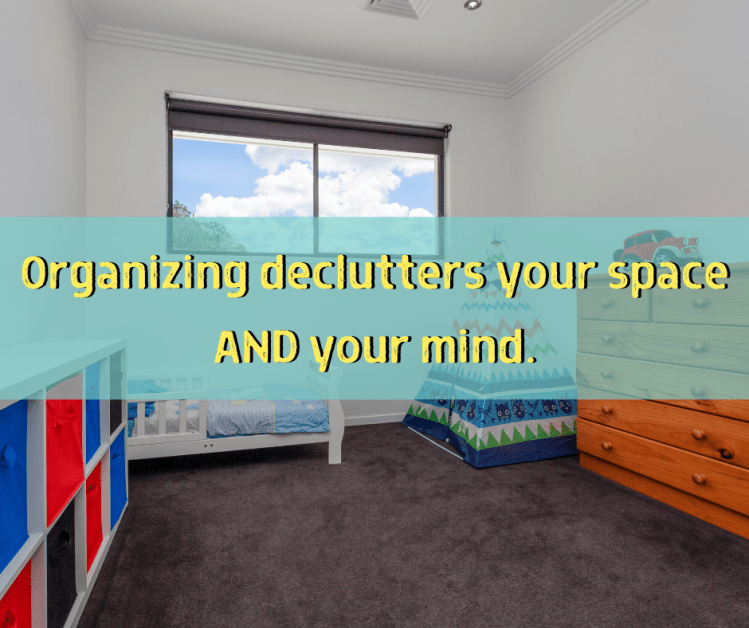
An organized space has so many benefits beyond a tidy home; it helps reduce stress, it saves money and time, and it boosts productivity. Your child won’t waste time frantically searching for homework or textbooks, you won’t run out and buy more gym shorts because you can’t find the ones that are growing scary things under your kid’s bed, and you won’t feel a need to wear protective gear every time you venture into your child’s room.
Plus, your kids learn good habits that will last a lifetime; at the very least, you can save yourself from tripping over yet another LEGOⓇ or Hot WheelsⓇ (ouch)!
Decluttering and getting organized doesn’t have to fall completely on your shoulders. Get your kids involved in the process; our son helped us with his closet redo and he ended up having a ball. Plus, when you give chores to kids, it’s a great way to help them learn responsibility, accountability, a good work ethic, and other important skills. The end result is a house with a little more breathing room, and you can breathe a little easier too!
*As an Amazon Associate I earn from qualified purchases.
 thefithouse
2 thoughts on “15 Ways Your Kids Can Help Declutter”